
Beekeeping
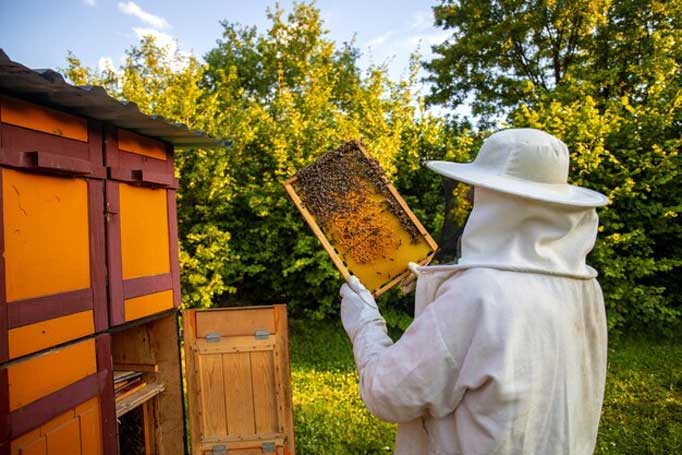
- This is not related to the sustainability services I offer. It is provided to give insight into how I think and live sustainability on a personal level.
- My opinion is that the success of a beekeeper is not measured by how many pounds of honey are gathered. Instead the measure of success is how many other beekeepers were positively impacted by my actions. My measure is that I helped three groups of co-workers start on the path towards becoming beekeepers. One individual from one of those groups now has his own apiary of four hives. That group of beekeepers is still active, they harvested over 50 pounds of honey in 2023 from a single hive! The other two beekeeping groups later decided to become less active in beekeeping, so my success is moderated by real life.
I have always been amazed by the power of best practice sharing. For years, we have held quarterly sustainability dialogs, we talk about positive changes happening in many different parts of the company. Associates in one function find gains from hearing about others, sometimes in seemingly unrelated areas. Product design, packaging design, manufacturing, product distribution, and consumer messaging all touch the same products. And associates in one business love to learn about what others businesses are doing so they can show their own leadership that striving for sustainability progress is ‘normal’.
An underrated group is the continuous improvement initiative. Within the company, each operation is expected to deliver a certain percentage of cost savings each year.
The relentless search for ways to save money is very much aligned with our desire to continually reduce environmental impacts.
When we find a way to purchase less material to make the same amount of product we are also reducing the amount of waste that is produced. This might save us some money and wasted effort to handle the waste materials… but the biggest savings is at our supplier, where they can use less material.
An oft-overlooked concept is to have a formal start-up and shut-down procedure. One business I know of saved $25,000 per year by turning off an infrequently used furnace. When they need the furnace, the length of time for the furnace to come up to temperature is about the length of time needed to prepare the material to go into the furnace. Of course, the reduction in energy use led to a direct reduction in greenhouse gas emissions.
I recommend using Life Cycle Assessment to inform cases where there is a trade-off. One example is the conversion to returnable packaging. It sounds like a great idea to eliminate cardboard and plastic packaging. But this reduction is balanced with the environmental impact of returning packaging to the supplier for reuse.
- In the spring of 2023 I had two bee hives at home. During the summer, within a three week span, my bees decided to turn it into four hives. I gladly accommodated their growth and am now working to ensure that all four hives make it to spring 2024. IN 2023 I was able to harvest 75 pounds of honey, most of which was given away as wedding favors for my daughter’s recent wedding.
- I live on a five acre property in the Wisconsin pine forest. My hives are next to two Lindenwood trees. These trees have yellow flowers throughout the leaf canopy and allow my bees to produce light-colored, mildly flavored honey.
- I use eight-frame Langstroth wooden hives. When I purchase queen bees I tend to purchase Carnolian bees, the genetics are known to produce a docile, hard-working, winter-tolerant bee. Carnolian bees tend to gather nectar in cool and overcast days at a higher rate than some other bees. They also rapidly adjust the bee population depending on the availability of nectar.
- Please let me know if you want to talk about bees, one of my favorite pastimes.